Price Increase: The Mathematical Strategy for Choosing Your Campsite Without Breaking the Bank
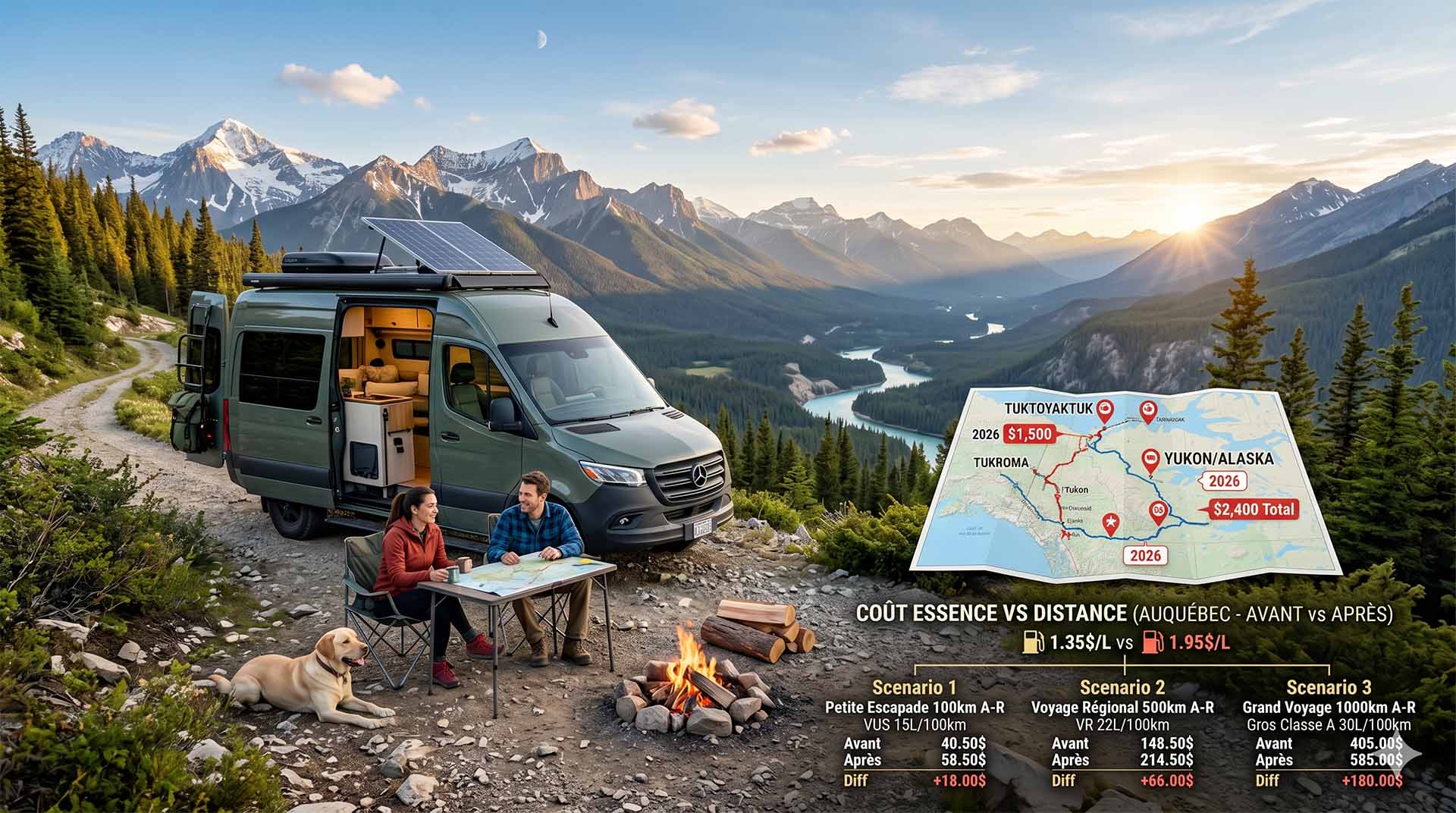


The legendary road trip to the West, Yukon, Alaska, and the ice road to Tuktoyaktuk in the Northwest Territories makes all freedom enthusiasts dream. But the current economic reality forces us to come back down to earth. For many, this once-in-a-lifetime journey had to be canceled or postponed due to a single variable: the astronomical cost of gas and accommodation fees. When crossing the continent becomes a major budget issue, the traditional planning method no longer works. Choosing your destination randomly or simply "on a whim" can turn your vacation into a financial pit. To keep traveling without sacrificing the comfort of services, you need to stop looking solely at the price of the night and start calculating the total stay cost (TSC). Here are the real solutions to cut fixed costs without cutting the fun. 1. The "Break-Even Point" Equation (Gas vs. Campsite) This is the classic mistake: driving 400 km more to go to a campground at $45 a night instead of stopping at a campground at $75 a night closer to home. Let's take out the calculator. If your towing setup or recreational vehicle consumes an average of 20 liters per 100 km, each 100 km costs you about $40 in gas in Quebec.
- Option A (Far): 500 km of road (200 $ in gas round trip) + 4 nights at 45 $ (180 $) = 380 $.
- Option B (Close): 100 km of road (40 $ in gas round trip) + 4 nights at 75 $ (300 $) = 340 $.
The concrete solution: The shorter your stay (less than 5 days), the more you should prioritize proximity, even if it means paying more for the campsite. The cost of gas instantly cancels out the savings of an affordable campsite if it is too far away. 2. Before vs After: The Real Impact of the Increase over 100, 500, and 1000 km Why are dream routes to the Far North falling one after another on campers' drawing boards? Because gas prices in Quebec have seen a historic jump, going from an average price of about 1.35 $ / liter a few years ago to an average that now hovers around or exceeds 1.95 $ / liter depending on the time and region. For an average vehicle or towing setup that consumes 20 liters per 100 km, here’s what this increase concretely represents for your transportation costs (Calculations based on a round trip):
- On a short getaway of 100 km (round trip):Before (at 1.35 $/L): You paid 27.00 $ in gas.
- Now (at 1.95 $/L): You pay 39.00 $. (+12.00 $ difference). A minimal impact that easily absorbs the costs of a good campsite.
- On a regional trip of 500 km (round trip):Before (at 1.35 $/L): The trip cost 135.00 $.
- Now (at 1.95 $/L): The same trip costs 195.00 $. (+60.00 $ additional costs).
- On a trip of 1000 km (round trip):Before (at 1.35 $/L): The transportation budget was 270.00 $.
- Now (at 1.95 $/L): It skyrockets to 390.00 $. That's 120.00 $ more just in gas for the same distance.
- Now imagine the impact on a trip to Yukon or Tuktoyaktuk, which represents over 12,000 km round trip: the increase alone adds nearly 1,500 $ in net expenses to the initial budget, not to mention that fuel prices rise exponentially as you isolate yourself in the Territories. How to track and outsmart prices by region? Regional taxes cause the price at the pump to vary by 10 to 25 cents per liter from one corner of Quebec to another. Regularly check official data before each departure. The golden rule: fill up as much as possible in major supply areas (like Mauricie or Chaudière-Appalaches, which are often more competitive) before entering remote or heavily taxed tourist regions (Montreal, Gaspésie, Côte-Nord). 3. The provincial network vs. private: The service match National and provincial parks (like the SEPAQ network in Quebec or Parks Canada) offer regulated rates that are often much lower than large private resorts. However, they rarely offer the full "3 services" (water, electricity, sewage) at all sites. How to choose? The "Semi-Service" tactic: Book a site with electricity only (2 services). It’s often 15 $ to 20 $ less per night than a 3-service site. Fill your fresh water tank at the entrance of the campground and use the free dump station upon departure. Over a week, that’s over 100 $ saved for exactly the same level of comfort inside the RV.
4. The areas designated by municipalities: The real safe bet In the face of growing prohibitions, venturing randomly to do unauthorized wild camping has become risky and can quickly result in a hefty fine, instantly nullifying your savings efforts. To avoid this, the solution lies in the officially designated areas by cities and towns to accommodate RVs for a free night.
- Legality and peace of mind: More and more welcoming municipalities are setting up specific spaces (municipal stops, dedicated parking lots, village parks) to encourage local tourism. It’s an infinitely safer option than risking it in an unregulated gray area.
- Check our interactive map: To help you plan your stops without stress, all these authorized and safe areas are listed directly on our interactive map. You will find strategic locations throughout the province to cut your accommodation costs legally.
5. Optimize the route: The hunt for slopes and resistance The choice of destination depends not only on the distance on the map but also on the topography of the route. Crossing a mountain range or driving against the wind on a highway at 115 km/h can increase your gas consumption by 30 to 40%. The solution: Choose destinations accessible via secondary roads (national roads) rather than major highways. Driving at 90 km/h instead of 115 km/h drastically reduces air resistance and protects your wallet while allowing you to discover often much more interesting landscapes. In summary: Your checklist before booking Before pulling out your credit card to book a site this summer, ask yourself these three questions:
- What is the real gas cost to get there and back based on the distance?
- Have I identified the free and authorized municipal areas on our map to secure my nights?
- Do I really need the "3 services" package every day, or can I maximize my tanks at a 2-service site?
Plan less far, but plan smarter: that’s the key to saving your camping season.