Solar energy in summer: Quebec vs Yukon and Alaska
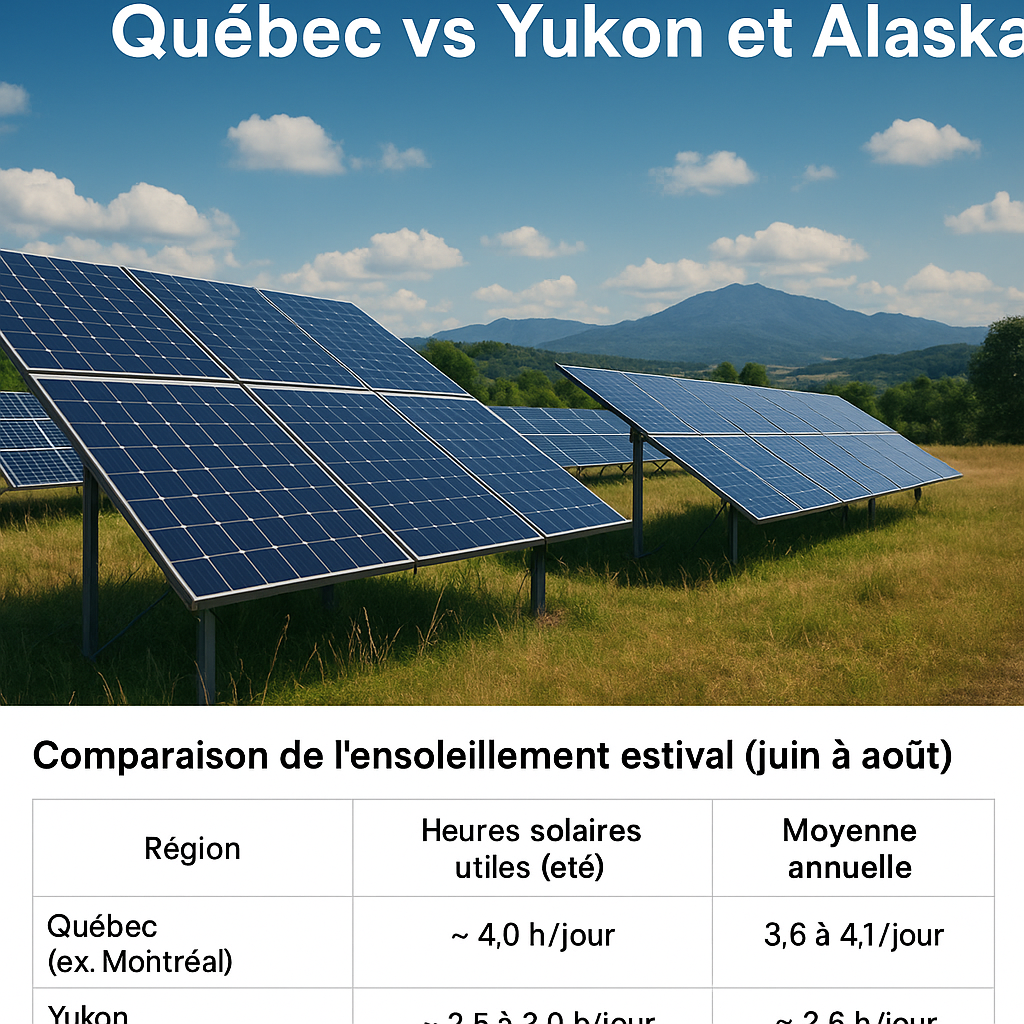


From early June to early September, many RV travelers or solar energy enthusiasts wonder about the performance of solar panels in the northern part of the continent. Does Yukon or Alaska offer better sunlight than Québec, particularly the Montréal area? The answer is not as simple as one might think, as it is important to distinguish between two key concepts: sunlight duration and useful solar hours (known as peak sun hours). What is a "peak sun hour"?
A peak sun hour corresponds to an hour during which the sun provides a light intensity of 1,000 W/m² — the maximum intensity that solar panels can efficiently convert. This figure is much more useful than simple daylight duration (e.g., 18 or 20 hours of day in the north), as it measures the actual recharging capacity. ?? Comparison of summer sunlight (June to August)
| Region Useful solar hours (summer) Annual average | ||
| Québec (e.g., Montréal) | ~ 4.0 h/day | 3.6 to 4.1 h/day |
| Yukon (e.g., Whitehorse) | ~ 2.5 to 3.0 h/day | ? 2.6 h/day |
| Interior Alaska (e.g., Fairbanks) | ~ 4.0 to 5.5 h/day | ? 4.0 h/day |
? Key Takeaways
- Québec, particularly in the Montréal area, offers very good solar performance in summer, with about 4 h/day of useful sunlight.
- Despite its long days, Yukon produces less useful solar energy due to the low angle of the sun and overall lower sunlight.
- Interior Alaska, particularly around Fairbanks, offers comparable or superior performance to Québec in summer, especially with well-oriented panels.
? For RV travelers or off-grid setups
If you are traveling north this summer and relying on solar to recharge your batteries:
- Québec remains a solid, stable, and predictable reference.
- Yukon may pose challenges for quick recharging unless you have additional batteries or very efficient panels.
- Interior Alaska is an excellent option for summer recharging, especially if the sky is clear.