The state of Quebec's lakes: what the latest data says
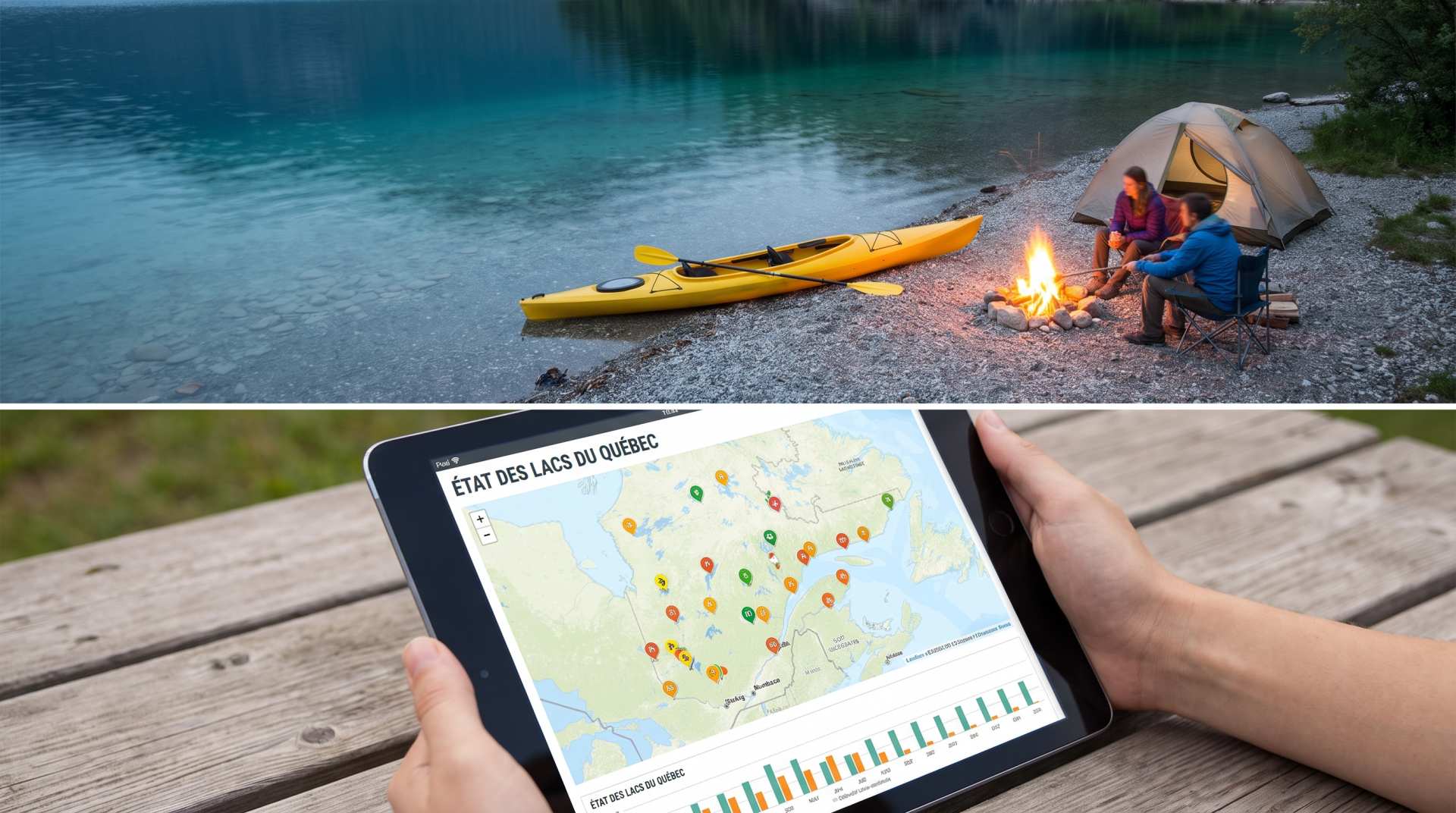


Are you spending the summer traveling through Quebec in an RV and enjoying a swim or a kayak outing between two nights of camping? The quality of a lake's water is not static: it evolves, and not always in a positive direction. An article from the Journal de Montréal published in 2020 highlighted this trend. Here’s what the most recent data from the government of Quebec says, and how it affects your stops by the water.
Who monitors the state of Quebec's lakes?
Since 2004, the Ministry of the Environment of Quebec has relied on the Voluntary Lake Monitoring Network (Réseau de surveillance volontaire des lacs - RSVL): hundreds of local associations collect samples themselves — water transparency, phosphorus, chlorophyll, dissolved oxygen — from over 850 lakes across the province, year after year. It is this ongoing field monitoring, rather than a single snapshot report, that allows us to see how a lake evolves over time.
What the latest data shows
According to the ministry's report, the lakes monitored by the RSVL are distributed as follows:
- 46 % are oligotrophic — the healthiest state, with clear water and low nutrient levels;
- 44 % have begun their eutrophication process — accelerated aging, often accompanied by murkier water and more algae;
- 10 % are already eutrophic, the most advanced state.
In other words, just over half of the monitored lakes currently show signs of accelerated aging. The ministry also specifies that phosphorus measurements taken between 2004 and 2017 were underestimated due to an analytical bias, which has been corrected since 2018 — a reminder that this data represents genuine scientific measurements, not mere impressions.
Why does a lake "age" faster?
Eutrophication is a natural phenomenon — all lakes age over hundreds or thousands of years. The problem arises when this process accelerates due to human activity: fertilizers and manure runoff from agricultural land, poorly maintained septic systems, deforestation of shorelines, or simply the pressure of increasingly dense residential development around a water body. The more phosphorus that enters a lake, the more algae and aquatic plants proliferate — and the clearer the water becomes.
What this means for your RV outings
Before choosing your next stop by the water, here are a few simple tips:
- A local shoreline association (often found by searching the name of the lake followed by "RSVL") usually publishes its latest results — a good way to know what to expect before setting up camp;
- A lake surrounded by forest rather than agricultural land or dense development statistically has a better chance of being in good condition;
- Your own habits matter: using biodegradable soap, properly managing a pit or portable toilets, and respecting riparian zones make a real difference, as explained in our charter of responsible travel.
The picture is not alarming: nearly half of the monitored lakes remain in excellent health. But it serves as a reminder that a water body, even one that appears beautiful, deserves to be treated with care.
Sources
Voluntary Lake Monitoring Network (RSVL) — Ministry of the Environment of Quebec
Status of phosphorus results in lakes — Ministry of the Environment of Quebec
The worst lakes in Quebec: a quarter of lakes have seen their condition deteriorate — Le Journal de Montréal, August 1, 2020